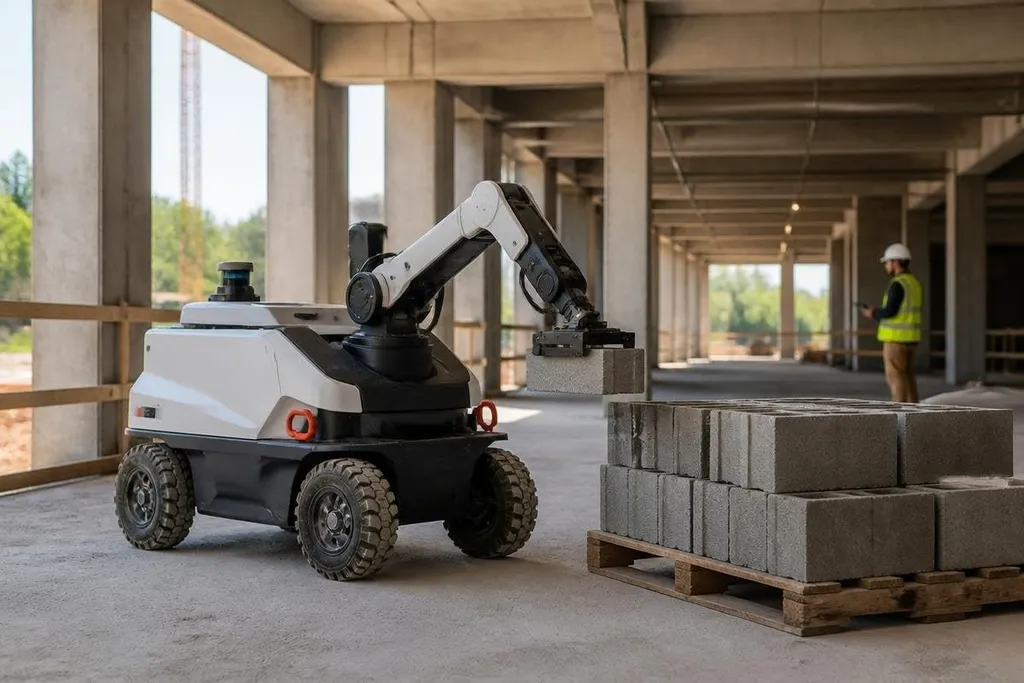
A construction robot won't arrive as a full building crew. It will first take on work that is repetitive, measurable, and hard on people, such as moving materials, scanning spaces, or placing the same piece many times.
The useful question is where a robot can work safely on a changing site, not whether it can perform a polished demo.
Quick read
- Repeated tasks are the first target because robots work best with clear steps and fixed tools.
- Mud, rain, loose ground, missing data, and other trades can stop a machine faster than a software demo suggests.
- The winning systems will fit existing crews, site plans, and safety rules rather than demand a new process.
Where robots fit first
Construction sites contain many tasks with the same basic motion. A robot may carry materials between two marked points, scan a floor for changes, drill a repeated pattern, or place units along a planned path.
Those jobs have a useful feature: people can describe what counts as a correct result. A scan can be checked against a site plan. A drilled hole can be measured. A material run can be counted. Clear checks give the robot a boundary and give the crew a way to catch errors.
A robot also needs a steady supply of work. A machine that spends most of the day waiting for materials, power, or a clear work area won't save much time, even if its arm moves faster than a person.
The site is the hard part
Factory robots work in marked spaces with known objects. A building site changes by the hour. A wall moves, a cable crosses the floor, a forklift blocks a route, and the surface under the wheels may be uneven.
Sensors can help the robot see walls, people, and objects. Cameras build images, LiDAR measures distance with light pulses, and location software helps the robot keep track of its position.
None of that removes the need for a person to check the work area.
Weather adds another limit. Dust can cover lenses. Rain can affect outdoor sensors. Heat can reduce battery life. A site manager will care about those failures more than a clean indoor demonstration.
Those weather limits make a construction robot’s work record more useful than a polished demo. A report should say whether the machine kept its sensors working and how often a worker had to reset it. Robot 24 can place those site details beside the task and test date, so you can judge whether the machine is ready for a crew’s daily work.
People will still run the job
Construction robots are likely to work beside crews, with a person setting the task, checking the area, and handling exceptions. That role may look closer to robot supervisor or machine operator than to a traditional trade role.
Training will matter because a crew needs to know when the robot is within its limits. They also need a fast way to stop it, move it, or return the task to a person. A machine that needs a specialist for every small fault creates a new delay instead of removing one.
The handoff between people and machines may decide whether a system stays on site. If a robot finishes one task but leaves tools, waste, or materials in the wrong place, the next trade pays for that gap.
Cost and proof
A construction robot has to earn its space, power, transport, setup time, repairs, and operator time. The purchase price is only one part of that bill, and future products may use rental or service fees instead.
The proof should come from repeated work on real sites. A single successful wall, scan, or delivery shows that a task is possible. It doesn't show how the machine handles a full week of changing conditions.
I'd wait for records from several sites before calling a construction robot ready for broad use. The useful numbers are task time, human hours needed, stoppages, rework, and the cost of keeping the machine running.
A practical buying check
Before a contractor tests a construction robot, check these points:
- Name the task: Write down the exact work, start point, finish point, and pass or fail check.
- Measure the site: Record floor condition, weather exposure, access routes, power, and space around the work area.
- Plan the handoff: Set out who loads materials, starts the task, checks the result, and stops the machine.
- Count the delays: Log setup, charging, blocked routes, sensor cleaning, faults, and repairs.
- Price the result: Compare the robot's full operating cost with the labor hours and rework it replaces.
- Set a stop rule: End the trial if safety checks fail or the machine needs more support than the task saves.
The next useful construction robot won't be the one with the longest task list. It will be the one that completes one defined job through a full site week, with its limits and running cost recorded.